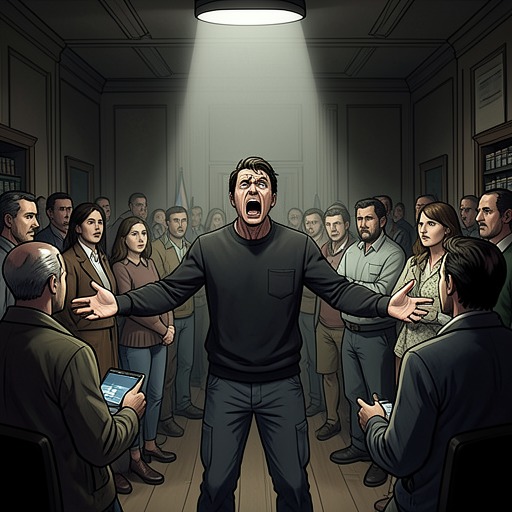
Bateman's confession to Harold Carnes
American PsychoBateman's confession to Harold Carnes is the climactic attempt by Patrick Bateman to force recognition of the crimes he has narrated as his private reality. He insists that he killed Paul Owen and tortured numerous women, but Harold Carnes refuses to accept the statement as factual. His dismissal leaves Patrick without the legal, social, or emotional acknowledgment that a confession ordinarily seeks, making the episode a decisive demonstration of the novel's unstable boundary between crime, performance, and hallucination.
Background and Investigative Context
The confession develops against an investigative thread that has already made Paul Owen's disappearance a public problem. Patrick encounters Donald Kimball, who says that Meredith Powell hired him to investigate the disappearance. Kimball has found an answering-machine message claiming that Paul went to London, although Paul's girlfriend doubts that explanation. More damagingly, Paul's datebook, verified by his secretary, places him at dinner with Marcus Halberstam on the relevant night, and Kimball says that he has questioned Marcus. These records and testimonies establish an external chronology that conflicts with Patrick's private account of violence.
The contradiction is sharpened by Patrick's earlier preparation for a meeting with Paul. He spends the day screening calls, exercising for two hours, eating lunch at the Health Bar, visiting Barney's after inspecting an abandoned loft building in Hell's Kitchen, receiving a facial, playing squash at the Yale Club, and making an eight o'clock reservation under the name Marcus Halberstam at Texarkana. He chooses the restaurant because people with whom he has dealings are unlikely to be there. The detail makes the encounter appear planned and materially grounded, while the assumed name, the carefully selected setting, and the later documentary evidence make identity itself part of the case.
The Confession in Conversation
At a crowded club, Patrick asks Harold whether he received the message Patrick left for him. Harold laughs and calls it hilarious, treating the confession as entertainment rather than evidence. He refers to the message about Bateman killing Owen and an escort girl as "bloody marvelous" and "Really key," then complains only that it was rather long. His response turns the language of criminal disclosure into another piece of social chatter, absorbed by the same milieu that treats clothing, drinks, names, and reputation as interchangeable signs.
Patrick then abandons indirection. He tells Harold that he killed Paul Owen, chopped off Owen's head, tortured dozens of girls, and meant every part of the message. When Harold continues trying to leave, Patrick repeats the claim with heightened insistence: "I-killed-Paul-Owen-and-I-liked-it. I can't make myself any clearer." The confession functions simultaneously as a factual assertion, a demand for recognition, and an act of self-definition. Patrick is not merely reporting violence; he is trying to make another person acknowledge the identity he believes the violence proves.
Harold's reply destroys that intended effect. He says the claim is impossible and that he is no longer finding it amusing. When Patrick demands an explanation, Harold states that he had dinner with Paul Owen twice in London only ten days earlier. The statement supplies a direct witness account that contradicts Patrick's central confession. Patrick's response, "No, you… didn't," loses the force of an assertion and emerges as a question, showing that the external testimony has destabilized even his own confidence in what he has claimed.
Evidence, Identity, and Unreliable Narration
The episode stages a conflict between several kinds of evidence: Patrick's first-person confession, Harold's personal testimony, Paul's datebook, the secretary's verification, the answering-machine message, and the girlfriend's skepticism. None of these materials is presented in a neutral legal proceeding, yet their collision produces the structure of an evidentiary dispute. Patrick offers the most emotionally forceful account, but Harold's calm reference to dinners in London makes that account impossible to confirm within the social world that surrounds him.
The name confusion surrounding the characters intensifies the problem. Patrick arranges the dinner under Marcus Halberstam's name, while Harold addresses him as Davis and later refers to Bateman as though discussing someone else. In this environment, a confession can be heard as a joke, a mistaken identity, or a bit of party performance before it can be heard as testimony. The social surface remains intact because the listeners possess habits for neutralizing disturbing speech: laughter, correction, dismissal, and a return to ordinary conversation.
Patrick's narration therefore cannot secure the meaning of its own events. He has described violent acts in concrete, carefully staged detail, including the use of cameras to film killings and the transformation of victims into objects of repeated viewing. Yet when he finally speaks openly, the world does not confirm the account. The result is not a simple exoneration. Instead, the scene preserves an unresolved gap between what Patrick says, what other characters can verify, and what the narrative has compelled the reader to witness through his perspective.
Consequences and Aftermath
The confession produces no arrest, interrogation, or public reckoning. Harold attempts to disengage, Patrick shouts after him, and the conversation ends with Harold still insisting that the killing is impossible. Patrick returns to the booth, takes Jean home, and uses a Halcion to numb himself. The immediate consequence is thus a retreat into sedation and routine rather than punishment or relief.
The failure is especially severe because Patrick has already tried to turn private dementia into public knowledge. In an earlier telephone episode, he leaves Harold a message admitting everything, claiming thirty, forty, or a hundred murders and mentioning that he left a woman in a parking lot near a Dunkin' Donuts somewhere around midtown. He concludes that he is a sick man, then calls again with a further message about possibly appearing at Da Umberto's. Police cars, ambulances, and a SWAT team are visible around a building while Patrick listens to the recorded message, but the scene does not yield a stable confirmation that the authorities have connected the violence to him.
Harold's later recollection converts that desperate message into a social anecdote. The confession is absorbed into laughter, club talk, and mistaken names, while Patrick remains trapped inside the need to be believed. Its decisive consequence is therefore ontological as much as legal: Patrick cannot establish whether he has revealed a hidden criminal self or performed a fantasy that no one else will recognize. The scene leaves him with the same condition from which he tried to escape, a private narrative of violence sealed inside a public world incapable—or unwilling—to read it as truth.
Narrative Significance
As an event, Bateman's confession to Harold Carnes concentrates the novel's opposition between appearance and reality. Patrick's polished social presentation, like the clothes, reservations, business identities, and conversational rituals surrounding him, provides a surface capable of containing almost any statement without visibly breaking. Even an admission of murder becomes another failed performance of status and personality.
The confession also exposes the limits of confession as a redemptive or evidentiary act. Patrick speaks with increasing literalness, but literalness does not guarantee credibility. Harold's counter-testimony does not simply prove Patrick innocent; it demonstrates that the novel's social world has no reliable mechanism for distinguishing a factual disclosure from a joke, a role, or a symptom. The scene's final uncertainty is consequently not a loose mystery to be solved by one missing document. It is the governing condition of Patrick's narration: violence may be real, imagined, repeated, or structurally indistinguishable from the performances through which these characters recognize one another.